
Exobiosphere and MaxWell Biosystems Partner to Bring High-Content Electrophysiology to Space
Exclusive agreement brings direct, high-resolution functional measurements of neuronal and cardiac activity to automated drug screening in microgravity
LUXEMBOURG and ZURICH, 21 September 2026 — Exobiosphere, the space biotechnology company advancing drug discovery and biomedical research in microgravity, and MaxWell Biosystems AG, a global technology leader developing high-density microelectrode array (HD-MEA) technology, today announced an exclusivity agreement covering the use of MaxWell Biosystems’ technology for commercial high-throughput space applications.
Under the agreement, Exobiosphere and MaxWell Biosystems have entered into an exclusive partnership for the use of MaxWell Biosystems’ HD-MEA technology for high-throughput electrophysiological recording and screening in microgravity, including its integration into Exobiosphere’s Orbital High-Throughput Screener (OHTS).
The integration will enable researchers to directly measure the function of electrically active cells — including neurons and cardiac cells — during microgravity exposure, adding a new layer of functional data to automated drug screening in orbit.
Studying cells in microgravity can reveal changes that cannot be observed under conventional laboratory conditions. Until now, many experiments in orbit have focused on observing changes in cell structure or state, with some functional information inferred through imaging or measurements performed after samples return to Earth.
MaxWell Biosystems’ HD-MEA technology provides a different approach: it enables direct, non-invasive and label-free measurement of cellular electrical activity.
“Microgravity changes how cells behave, but until now our partners have largely had to infer function from what could be imaged or measured after the fact,” said Dr. Bruno Santos, Director of R&D and co-founder of Exobiosphere. “Electrophysiology tells us what a neuron or a cardiomyocyte is actually doing while it is in orbit. For a drug programme, that is a critical question: does a compound change cellular function, and at what concentration? That is what makes the data worth flying for.”
When integrated into OHTS, the technology will allow Exobiosphere and its partners to capture functional measurements from neuronal and cardiac models while they are exposed to microgravity. These measurements can include network activity, signal propagation, action potential characteristics and arrhythmia-like events, providing insight into how cells respond to compounds under spaceflight conditions.
MaxWell Biosystems’ MaxTwo is a multi-well HD-MEA platform for scalable, label-free recording and stimulation. Each well features 26,400 electrodes at a density of 3,265 electrodes per square millimetre, enabling functional measurements from network activity down to cellular and subcellular signals. The system is designed to work with automated liquid handling and plate movement, making it suitable for integration into Exobiosphere’s automated experimental platform. Exobiosphere will qualify the system for flight and integrate it into OHTS, which combines automated cell culture, compound dosing and data capture without crew intervention.
“We are very excited to take this next step with Exobiosphere. MaxTwo has already been used to characterize the functional activity of brain organoids following long-duration spaceflight. This collaboration now creates the opportunity to bring high-content electrophysiology directly into the spaceflight workflow, capturing how electrically active cells respond during microgravity exposure, at high resolution and at scale. We look forward to the new biological insights this will enable for disease modeling and drug discovery,” said Giulio Zorzi, Head of EMEA at MaxWell Biosystems.
Together, Exobiosphere and MaxWell Biosystems are taking space-based drug discovery a step further, combining advanced high-content electrophysiology with automated biological research to unlock new ways of studying disease and drug response in orbit.
About MaxWell Biosystems
Founded in 2016 as a spin-off of ETH Zurich and headquartered in Zurich, Switzerland, with a US office in San Diego, MaxWell Biosystems develops high-density microelectrode array technology for recording, stimulating and interpreting the electrical signals of neurons and other electrically active cells. Its MaxOne single-well HD-MEA and MaxTwo multi-well HD-MEA platforms, together with the all-in-one MaxLab Live software, are used by academic, biotech and pharmaceutical researchers in more than 25 countries. www.mxwbio.com — [email protected]
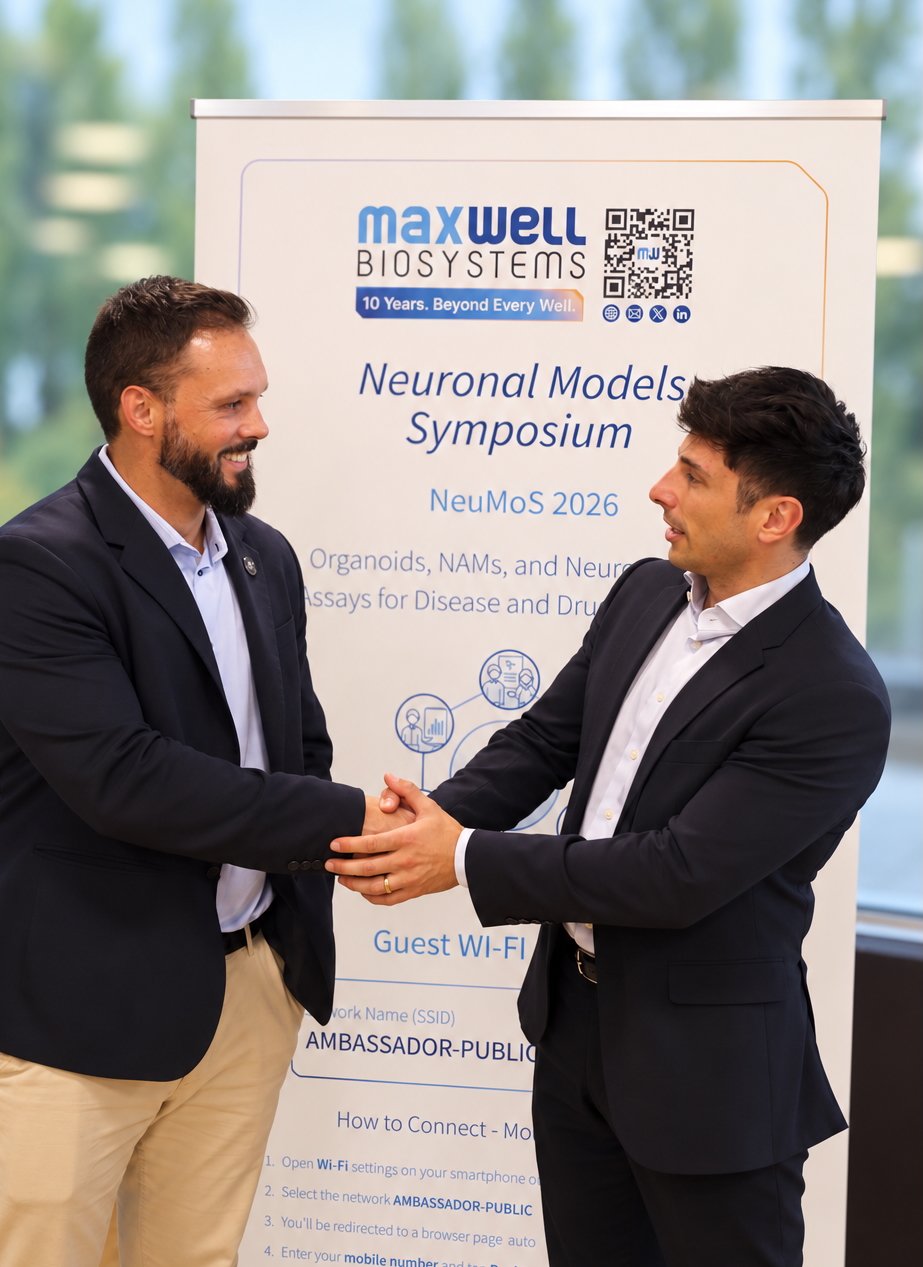
Dr. Bruno Santos, Director of R&D and co-founder of Exobiosphere and Giulio Zorzi, Head of EMEA at MaxWell Biosystems.