
UTHealth Houston and Exobiosphere Team Up to Take Biomedical Research to Orbit
Houston partnership will explore whether microgravity can unlock new medicines — combining Exobiosphere’s orbital high-throughput platform with UTHealth Houston’s expertise in antibody discovery, therapeutics and AI
HOUSTON — 24 September 2026 — What if the next breakthrough medicine is discovered not in a laboratory on Earth, but in a laboratory orbiting above it? UTHealth Houston and Exobiosphere, Inc., a space biotechnology company developing high-throughput research capabilities in microgravity, today announced a memorandum of understanding to collaborate on space-based biomedical research and explore the development of a Space Medicine Laboratory at TMC3 in the Texas Medical Center.
The partnership brings together UTHealth Houston’s expertise in medicine, antibody discovery, therapeutics and artificial intelligence with Exobiosphere’s Orbital High-Throughput Screening (OHTS) platform, creating an opportunity to conduct repeated, standardized biomedical experiments in microgravity and bring the resulting data back into drug-discovery programs on Earth.
At its core, the collaboration will investigate a provocative possibility: Can the unique environment of space become a new laboratory for discovering and developing life-saving medicines? The initial research program will focus on antibody expression, antibody formulation and crystallization, accelerated drug-candidate discovery, and the development of AI-ready multimodal datasets generated from orbital experiments and matched ground controls.
A New Kind of Biomedical Laboratory
For decades, scientists have used space to study how humans and biology respond to microgravity. The next frontier is to ask whether space itself can become a tool for drug discovery. Exobiosphere is developing technology designed to make that possible.
Its Orbital High-Throughput Screening (OHTS) platform is designed to support standardized, repeatable experiments in orbit, with corresponding experiments conducted on Earth as controls. Rather than treating each space experiment as an isolated mission, the platform is intended to enable successive research campaigns in which results can inform the next set of experiments. That capability could fundamentally change how researchers use the space environment for biomedical discovery—moving from individual experiments in orbit toward repeatable, data-rich research programs.
Under the collaboration, UTHealth Houston scientists are expected to lead research efforts, while Exobiosphere will contribute experimental design, payload integration and mission operations through its OHTS platform. Certain activities are anticipated to be conducted through Exobiosphere’s planned Houston laboratory.
The initial areas of potential research include:
Microgravity antibody expression — investigating how the space environment affects the production and behavior of therapeutic antibodies.
Antibody formulation and crystallization — studying concentration and crystallization characteristics relevant to structural biology and therapeutic development.
Accelerated antibody drug-candidate discovery — exploring whether high-throughput screening in orbit can contribute to identifying new therapeutic candidates.
AI-ready multimodal data — developing standardized datasets that combine orbital experiments with corresponding ground-based controls to support artificial intelligence and machine-learning research.
The parties also anticipate exploring additional research opportunities and pursuing external funding and potential industry partnerships.
Where Space, Medicine and AI Converge
The collaboration represents a new dimension of UTHealth Houston’s growing Space Medicine program, which brings together clinical medicine, biomedical research, therapeutics and artificial intelligence to address challenges associated with human spaceflight and translate discoveries from space into better health on Earth.
“Houston has always been a city where space and medicine come together. We now have an opportunity to take that relationship somewhere it has never gone before,” said Bentley J. Bobrow, MD, professor and vice president of healthcare innovation at UTHealth Houston and executive director of the UTHealth Houston Space Medicine program. “Our vision is to build a Space Medicine ecosystem in Houston where scientists, physicians, AI researchers and industry partners can use space not simply as an environment to study, but as a laboratory for discovery. Exobiosphere gives us an exciting new capability to pursue that vision.”
The planned Space Medicine Lab at TMC3 would provide a physical focal point for this emerging collaboration, bringing together UTHealth Houston investigators and industry partners to pursue research at the intersection of human spaceflight, microgravity, therapeutics and AI.
Turning Orbital Experiments Into Biomedical Intelligence
A key component of the partnership will be the development of an AI-ready data infrastructure linking experiments conducted in orbit with matched experiments on Earth.
“The real opportunity is not simply to conduct experiments in space,” said Xiaoqian Jiang, PhD, chair of the Department of Health Data Science and Artificial Intelligence. “It is to systematically generate high-quality data from those experiments, integrate it with ground-based data and use AI to identify patterns and biological insights that might otherwise remain hidden.”
For UTHealth Houston, the ability to connect orbital experiments with advanced AI and drug discovery could create a new research model: send biological questions to orbit, generate data in space, and bring the discoveries back to patients on Earth.
Houston’s Next Frontier in Drug Discovery At the center of the initial biomedical effort will be Zhiqiang An, PhD, director of the Texas Therapeutics Institute, professor of molecular medicine, and the Robert A. Welch Distinguished University Chair in Chemistry at McGovern Medical School, as well as the vice president of drug discovery at UTHealth Houston, whose research program has helped establish Houston as a center for antibody discovery and therapeutic development.
“We have spent years building the scientific capabilities to discover and develop antibody therapeutics,” An said. “Now we have an opportunity to ask what happens when we conduct that research under conditions we simply cannot reproduce on Earth. The combination of Exobiosphere’s orbital platform and our drug-discovery capabilities could open an entirely new avenue for therapeutic discovery.”
For Exobiosphere, the partnership provides an opportunity to deploy its orbital research capabilities alongside one of the world’s largest biomedical communities. “The next era of space biotechnology is not simply about putting experiments in orbit,” said Kyle Acierno, chief executive officer of Exobiosphere. “It is about making space a productive part of the biomedical research process. By combining our Orbital High-Throughput Screening platform with UTHealth Houston’s expertise in antibody discovery, therapeutics and AI, we can begin asking questions that could not be answered in a conventional laboratory.”
Acierno added that Houston provides a uniquely powerful environment for that effort.
“Houston has the space industry, the Texas Medical Center and an extraordinary concentration of biomedical expertise. We see an opportunity to build something here that can have an impact far beyond Houston.”
From Houston to Orbit—and Back to the Patient
The partnership reflects a broader vision for Houston’s role in the future of space medicine and biotechnology: not simply sending humans farther into space but using space to advance human health. The MOU establishes a framework for collaboration between UTHealth Houston and Exobiosphere. Specific research projects, funding commitments, intellectual-property arrangements and other obligations will be addressed through subsequent agreements between the parties.
About UTHealth Houston
UTHealth Houston is Texas’ resource for healthcare education, innovation, scientific discovery, and excellence in patient care. With more than half a century of experience, UTHealth Houston is one of the nation’s most comprehensive academic health centers.
Media Contacts UTHealth Houston
Sydney Lowther, Media relations specialist, [email protected], 713-500-3173
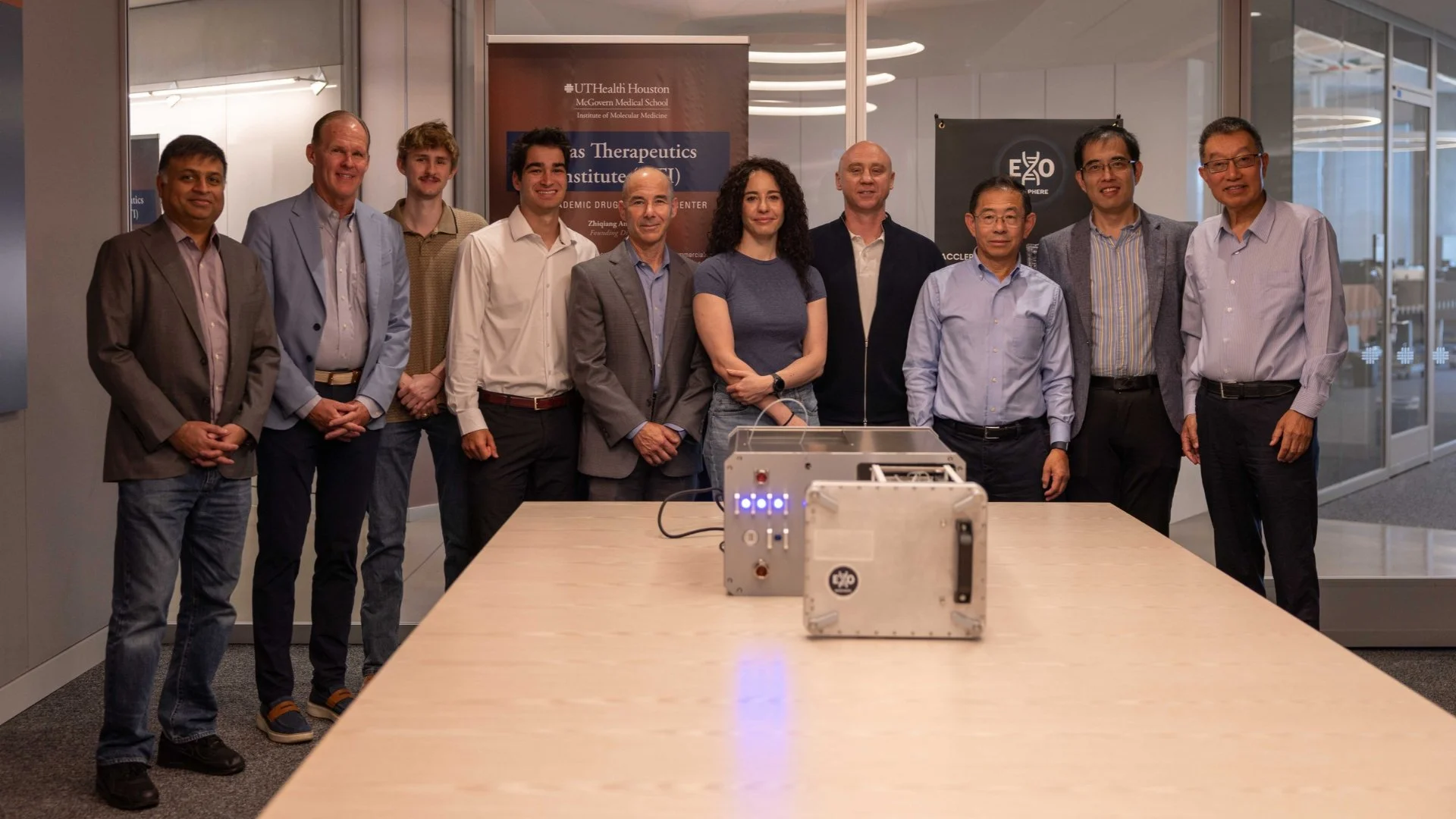
Photo by UTHealth Houston