
Exobiosphere Announces OH(T)SIZON to Advance Neuroinflammation Drug Discovery in Microgravity
LUXEMBOURG – 13 February 2026 - Exobiosphere, in collaboration with the Luxembourg Centre for Systems Biomedicine (LCSB) at the University of Luxembourg, announces the launch of OH(T)SIZON, a research project supported by an FNR Industrial Fellowship awarded to Dr. Beatriz Silva. The fellowship is carried out through a collaboration between the research groups of Prof. Michael T.Heneka and Prof. Carole Linster at the LCSB and Exobiosphere.
“Innovation and partnerships are central to our research, and this project is a prime example of that,” underlines Prof. Michael Heneka, director of the LCSB. “It is the start of a collaboration with a dynamic new R&D start-up that leverages our combined expertise to develop innovative, impactful technology, and provides a career-developing opportunity for one of the LCSB's young scientists.”
Spaceflight is known to disrupt immune regulation and can drive persistent inflammation—mechanisms also implicated in neurodegenerative diseases such as Alzheimer’s and Parkinson’s. Microgravity has been shown to alter key inflammatory pathways, including activation of the NLRP3 inflammasome, a protein complex involved in cytokine release. The project will optimize the end-to-end screening workflow both on Earth and under simulated microgravity conditions by configuring Exobiosphere’s Orbital High-Throughput Screener (OHTS), an automated, microgravity-compatible platform capable of conducting 2,000+ standardized tests per mission (depending on configuration), with a cell-based inflammation assay incorporating a human monocyte reporter system.
“Being part of OH(T)SIZON is both a privilege and a source of genuine excitement for me as a scientist,” said Dr. Beatriz Da Silva. “Through this collaboration between Exobiosphere and the LCSB, we are laying the groundwork for an innovative platform that will enable high-throughput screening of anti-inflammatory compounds under space-like conditions. This approach allows us to measure key indicators of brain inflammation, cell health, and survival in ways that are not possible on Earth. As an FNR Industrial Fellow, I’m grateful to contribute to this groundbreaking effort, which could help protect astronaut health while inspiring new therapeutic strategies for diseases such as Alzheimer’s and Parkinson’s.”
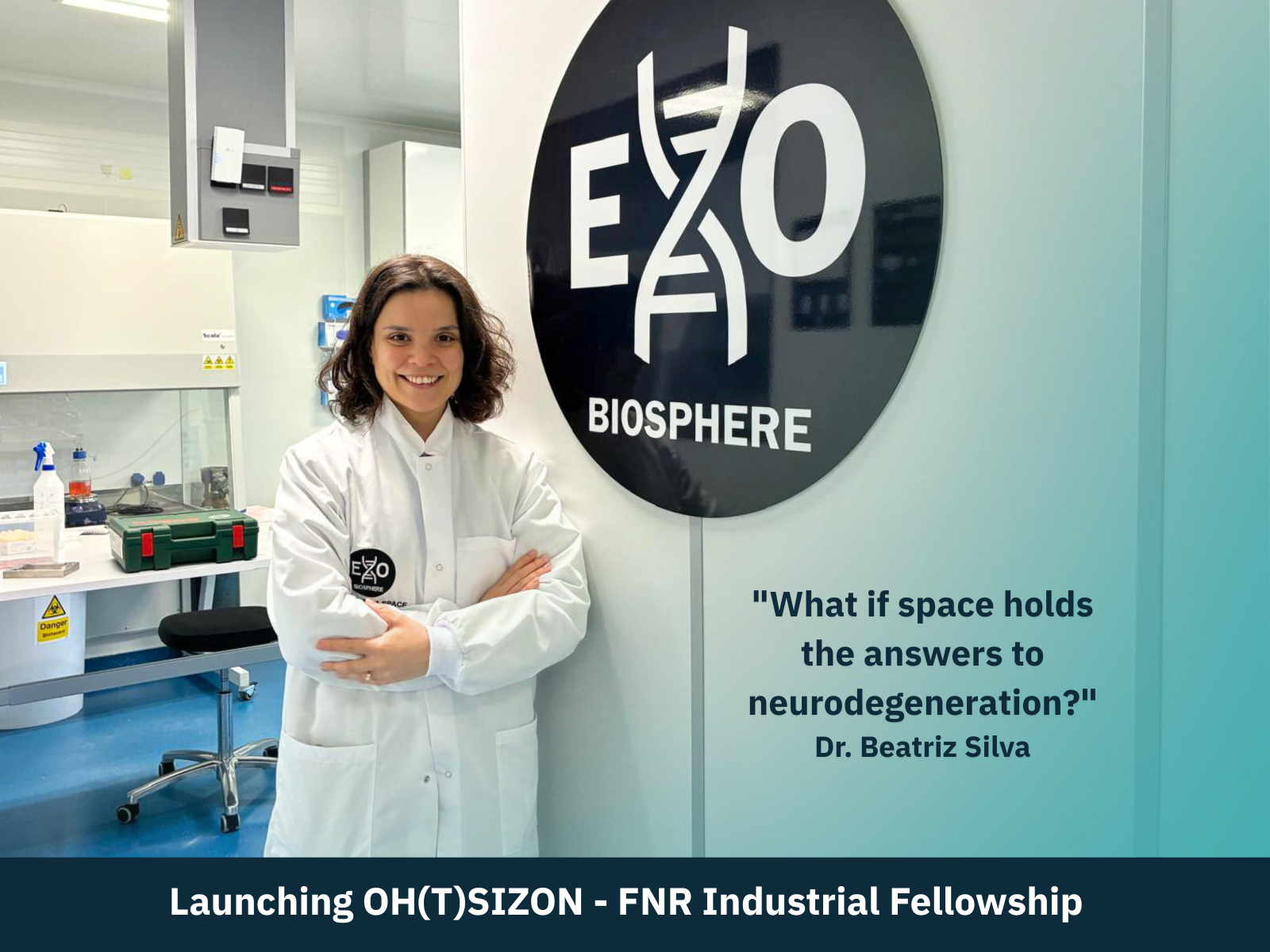
Dr. Beatriz Silva in Exobiosphere’s laboratory
Using integrated, multi-parameter readouts, including inflammatory signaling, organelle function, cytokine production, and cell viability, the project will compare terrestrial baseline profiles with cellular responses under simulated microgravity as a starting point, in preparation for future space missions. Candidate anti-inflammatory compounds will be evaluated using dose–response relationships, efficacy metrics, and response kinetics to prioritize leads for follow-on studies. In parallel, the project will strengthen scalable, space-enabled screening capabilities to support future research partnerships and commercial services.
“This groundwork is essential for establishing the most advanced human disease in vitro models within our platform,” said Dr. Bruno Santos, Director of R&D at Exobiosphere. “By validating these systems on Earth and under simulated microgravity, we are building a foundation that can later be deployed in space—where compressed disease timelines can reveal therapeutic opportunities far more rapidly. Our goal is to harness these unique conditions to accelerate the discovery of treatments with the potential to benefit millions of patients back on Earth.”
By combining automation, high-content cell profiling, and the unique biological effects of microgravity, Exobiosphere and its partners aim to advance neuroinflammation research in ways that benefit astronaut health and accelerate the development of improved treatments for patients on Earth.