
Luxembourg Centre for Systems Biomedicine (LCSB) and Exobiosphere Launch “Gravity-AI” to Advance Predictive Models for Neurodegeneration in Space and on Earth
LUXEMBOURG – February 18, 2026 - Exobiosphere and the Luxembourg Centre for Systems Biomedicine (LCSB) at the University of Luxembourg, launch a collaborative research project aimed at developing microgravity-enabled AI predictive models to better understand and anticipate neurodegeneration in both spaceflight conditions and on Earth.
Gravity-AI brings together complementary expertise in systems biomedicine, in-vitro disease modeling, microgravity research, and AI-driven analysis to explore how altered gravity and related stressors may accelerate cellular pathways involved in neurodegenerative diseases such as Parkinson’s disease and Alzheimer’s disease.
The €1.4 million project has been funded under the FNR AI-HPC BRIDGES Call 2025, with the University of Luxembourg leading the computational aspects, funded by the Luxembourg National Research Fund (FNR), and Exobiosphere leading the microgravity data generation and integration into a final product, supported through the Ministry of the Economy.
“Gravity-AI is designed to bridge cutting-edge space biology with high-performance computing and modern machine learning,” said Prof. Alexander Skupin, Head of the Integrative Cell Signalling group at the LCSB and co-lead of the project. “By combining advanced experimental models with predictive AI approaches, we aim to generate insights that can translate into better disease understanding and future therapeutic strategies.”
From Exobiosphere’s side, the project aligns with the company’s mission to develop predictive in-vitro disease models, leveraging microgravity testing, and to provide AI-driven tools supporting predictive therapeutic discovery.
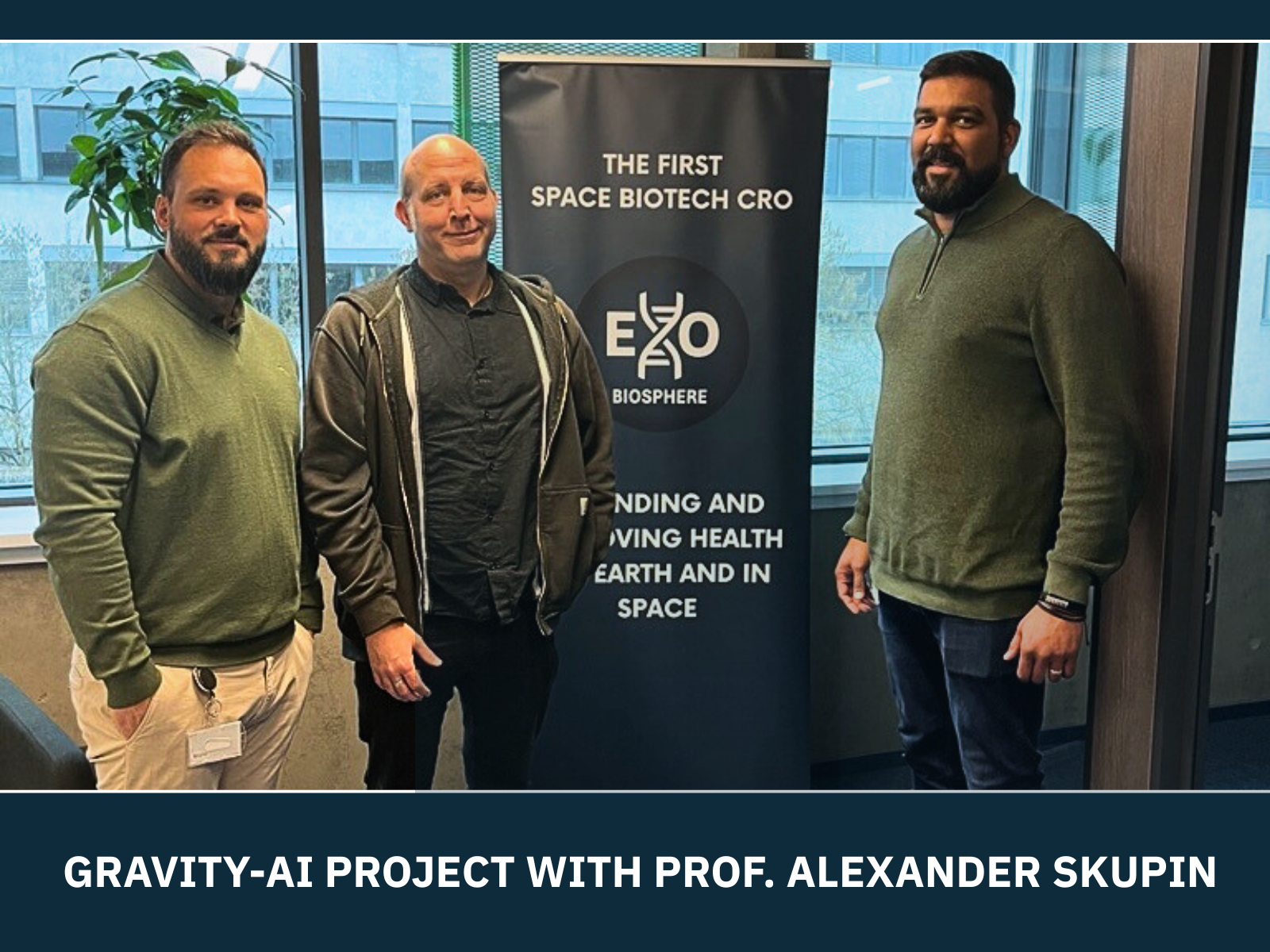
Dr. Bruno Santos, Prof. Alexander Skupin, Sandro Pereira
“Neurodegenerative diseases remain one of the most complex challenges in medicine,” said Dr. Bruno Santos, director of R&D and Co-Founder of Exobiosphere. “This collaboration reflects a shared ambition: to build better models that are not only scientifically accurate, but also useful to patients, helping researchers and innovators better predict disease trajectories and responses to interventions.”
Gravity-AI will run from May 2026 to April 2028, and will be jointly led by Prof. Alexander Skupin (Head of the Integrative Cell Signalling group, LCSB) and Bruno Santos (Director of Research & Development, Exobiosphere).
Find more information in the press release on the Luxembourgish government website.