
Exobiosphere selected by ESA to Deliver End-to-End Microgravity Research Service
Luxembourg –Exobiosphere has been awarded a contract by the European Space Agency (ESA), under the End-to-End Utilisation Service Procurement for Science and Research in Microgravity, to design, qualify, and operate a full-service automated biology platform in low-Earth orbit on Vast’s Haven-1 using its Orbital High-throughput Screener (OHTS). Haven-1 is scheduled to be the world’s first commercial space station when it launches in 2027.
Under this contract, Exobiosphere will deliver a complete end-to-end service: from open science selection, through hardware qualification and mission preparation, to the execution of automated biological experiments in orbit and the return of scientific data to research teams on Earth.
At the core of the service is Exobiosphere’s OHTS, a compact, autonomous platform capable of running over 2,000 automated experiments per mission. The OHTS automates fluid handling, media dispensing, and sample processing in microgravity, removing the need for crew intervention and enabling a level of experimental throughput previously unavailable in orbit.
“Haven-1 was designed in part to support automated scientific services like OHTS and sustain critical microgravity research after the ISS retires. ESA’s investment signals a broader shift toward commercially enabled science in low Earth orbit.” shared Max Haot, CEO of Vast. “Exobiosphere’s selection demonstrates the market’s confidence in the future of commercial space stations, and we’re proud that Haven-1 will serve as the platform enabling this next generation of microgravity research.”
The contract reflects ESA’s strategy to prepare for the post-ISS era, investigating new opportunities with commercial providers for low Earth orbit to gain operational experience with end-to-end service providers while creating reliable pathways for European research in orbit.
Science selection will be conducted as an open, competitive process expected to start by the end of May, through ESA’s Open Space Innovation Platform (OSIP), ensuring broad access for European academic and industry research teams. Proposals will be peer-reviewed and assessed for technical feasibility before a final recommendation for selection is made to ESA.
To support mission resilience, Exobiosphere has also secured agreements with multiple compatible microgravity platforms ensuring flight optionality in the event of scheduling changes.
“This contract marks a significant step in making microgravity a practical and accessible resource for biomedical research in Europe,” said Kyle Acierno, CEO of Exobiosphere. “For the first time, research teams across Europe would be able to run high-throughput biology in orbit the same way they run it on the bench, automated, reproducible, and at scale. We’re building the infrastructure that makes space a routine part of drug discovery.”
Antonella Sgambati, LEO Payloads Team Lead stated at ESA-HRE, “This type of missions represents an important step in ESA’s efforts to expand access to commercial low Earth orbit services, in partnership with European companies such as Exobiosphere, enabling and continuing our support for research and technology development.”
The project will run from 2026 through mid-2028. Key milestones include science selection (September 2026), a service implementation review (April 2027), and a mission readiness review ahead of the target flight on Vast, currently scheduled in 2027.
Refer ESA Exploration Science website : https://explorationscience.esa.int
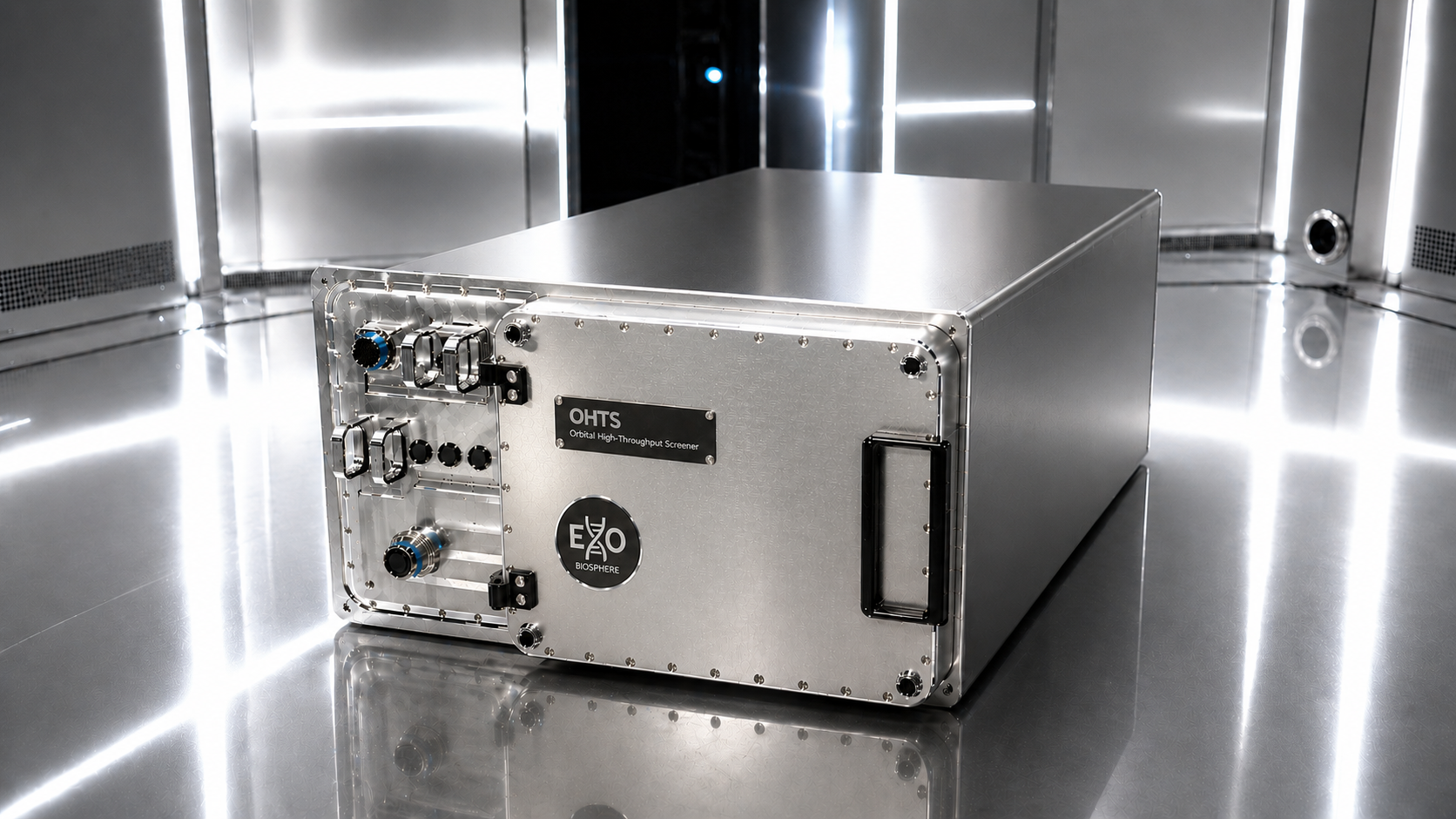
Exobiosphere’s Orbital High-throughput Screener (OHTS)
This activity is carried out under a programme of, and funded by, the European Space Agency. The views expressed in the materials arising from this activity reflect those of Exobiosphere and can in no way be taken to reflect the official opinion of the European Space Agency.